
Weight-loss guide
Mounjaro Click Counting: CQC Safety Expectations and Our Approach
What should a regulated provider consider before supporting an off label Mounjaro partial dose? We explain the safety, competency and governance standards behind our approach.Bernard Beben, Pharmacist & Co-Founder · 18 July 2026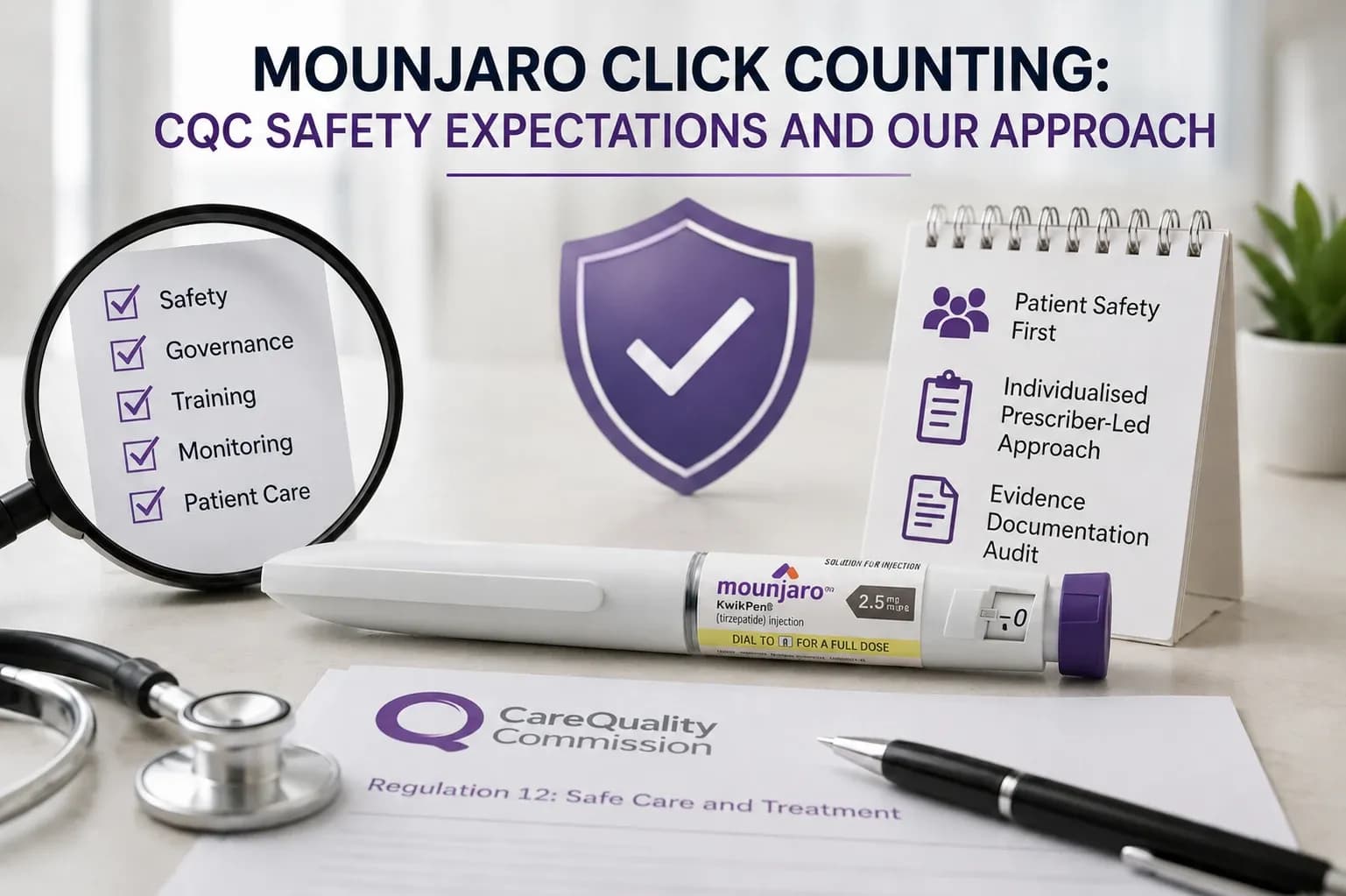
When a regulated provider considers an off label Mounjaro partial dose, the decision involves much more than calculating an amount. Safe care depends on clinical justification, patient understanding, accurate instructions, monitoring and governance.
The Care Quality Commission regulates health and care services rather than approving an individual click counting method. Its standards require providers to assess risk, manage medicines safely and demonstrate that care is delivered by appropriately qualified and competent professionals.
How CQC standards apply to Mounjaro prescribing
CQC Regulation 12 on safe care and treatment requires care and treatment to be provided safely. Its guidance includes assessing risks, doing what is reasonably practicable to reduce them, reviewing medicines when treatment changes and ensuring medicines are administered accurately in accordance with prescriber instructions.
For Mounjaro partial dosing, those principles create important questions. Is there a genuine clinical reason? Has the patient followed an appropriate treatment pathway? Can the intended amount be administered reliably? Does the patient understand the method and its limitations? How will the decision and outcome be monitored?
Why click counting needs additional safeguards
The UK Mounjaro KwikPen instructions for use describe fixed doses and do not provide an approved partial dose click chart. Using movements or clicks to administer another amount is therefore off label.
Off label prescribing is not the same as routine manufacturer directed use. It creates additional responsibility for the prescriber to explain the uncertainty, document why the option is suitable and put proportionate controls in place.
The main risks include:
- Administering more or less tirzepatide than intended.
- Confusing the labelled pen strength with the prescribed partial dose.
- Reusing instructions with a different pen strength.
- Changing the dose without clinical review.
- Using a non standard approach without suitable follow up.
Individual prescribing rather than a standard shortcut
A regulated prescribing service should not treat click counting as a universal treatment pathway or a self service way to make a pen last longer. Any decision must arise from an assessment of the individual patient.
Elixo’s approach
Our standard practice follows established Mounjaro initiation and titration schedules. We may only consider a partial dose in a carefully selected case where the prescriber identifies a genuine clinical reason and judges that the potential benefit outweighs the additional uncertainty.
Possible clinical considerations may include troublesome adverse effects after an increase, a need for a more gradual adjustment or an individual maintenance plan. These circumstances support a clinical review; they do not guarantee that partial dosing will be approved.
Cost alone is not accepted as the clinical justification for an off label dose.
Appropriate initiation and dose escalation
Before considering a non standard amount, the prescriber should understand how treatment was initiated, which strengths have been used, the duration at each stage and why a change is being requested.
Dose escalation should reflect treatment response, tolerability, adverse effects and patient safety. A higher strength pen should not bypass the need for an appropriate clinical and titration history.
Elixo’s approach
We review the patient’s current dose, previous strengths, treatment response, weight trend and adverse effects. Any departure from routine dosing requires a documented individual rationale rather than being applied automatically.
Verifying clinical information
Safe prescribing depends on reliable information. Relevant checks may include identity, age, current weight and BMI, medical history, medication history, contraindications, previous treatment and adverse effects.
Elixo’s approach
Patients complete a structured medical assessment covering demographic details, medical and medication history, height and weight. Photographic weight evidence may be requested, and available health records may be used to support verification where appropriate and permitted.
Consultation and patient competency
A questionnaire alone may not resolve uncertainty about an off label administration method. The clinician needs to establish that the patient understands the difference between the strength printed on the pen and the amount prescribed.
The patient should understand:
- That the proposed method is outside routine manufacturer instructions.
- The exact medicine, pen strength and intended weekly dose.
- The individual reason the approach is being considered.
- The possibility of dose variability and other relevant risks.
- That the dose and method must not be changed independently.
- When follow up is required and who to contact if anything is unclear.
Elixo’s approach
All patients receive clinician review and a telephone consultation before prescribing. Where a partial dose is considered, understanding and ability to follow the individual instructions are assessed. We do not support the approach where there are concerns about comprehension, reliability or safeguarding.
Informed agreement and written instructions
The patient should be told clearly that click counting is off label and is not supported by a manufacturer approved click chart. The discussion should cover the expected benefit, reasonable alternatives, material risks and additional uncertainty. Patients should also be directed to the current Mounjaro patient information leaflet for the authorised safety and administration information supplied with the medicine.
Written instructions should identify the exact pen strength and intended amount. An instruction issued for one strength must not be assumed to apply to another.
Monitoring at repeat prescribing
Approval of an off label plan should not become an indefinite instruction. Repeat prescribing provides an opportunity to verify that the patient is following the agreed method and that treatment remains beneficial and tolerable.
Elixo’s approach
Relevant repeat reviews capture the current pen strength, intended administered dose, method, adverse effects, weight and BMI. Inconsistency, uncertainty or a change in circumstances triggers clinical review before further prescribing.
Governance beyond the consultation
CQC expectations extend beyond an individual clinical record. CQC Regulation 17 on good governance requires effective systems and processes to assess, monitor and improve the quality and safety of services. A provider should have policies, risk assessments, audit arrangements, incident reporting and clear responsibilities between the prescribing service and dispensing pharmacy.
Useful audit questions include whether the rationale was recorded, off label status was discussed, instructions matched the pen strength, competency was assessed, follow up occurred and adverse effects or dosing discrepancies were identified.
Documentation does not turn an off label method into manufacturer approved use. It allows the service to demonstrate whether the additional risks were recognised, justified, explained and monitored.
What patients should take from this
Click counting and microdosing should never be treated as independent dosing techniques. Online charts cannot decide whether a partial dose is suitable, and a mathematically precise result may still be clinically inappropriate.
If you have been prescribed a partial dose, you should know the exact pen strength, intended amount, method, off label status, main risks and follow up plan. Contact your prescriber before changing any part of that plan.
Read our guide to clinician directed Mounjaro half doses and our Mounjaro click counting guide and safety guide. The guide only cross checks a dose already prescribed and must not be used to choose or change treatment.
Frequently asked questions
Does the CQC approve Mounjaro click counting?
The CQC regulates services and their safety systems. It does not provide a general approval for an individual off label click counting method.
Why is patient competency important?
A patient must be able to distinguish the pen strength from the intended partial dose, follow the exact instructions and recognise that the method cannot be changed or transferred independently.
Can patients calculate their own partial dose?
No. The treatment decision and exact directions must come from the responsible prescriber after an individual assessment.